
FoldsQ
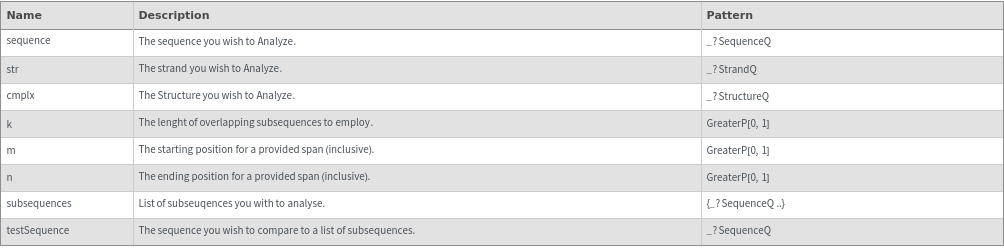
FoldsQ[sequence,k]⟹folds
this function returns true if in the provided sequence a fold of lenght k exists anywhere in the sequence.
FoldsQ[sequence,k,Span[m,n]]⟹folds
this function returns true if in the provided sequence a fold of lenght k exists in the space from position m to n.
FoldsQ[str,k]⟹folds
this function returns true if in the provided strand a fold of lenght k not designated by motif Pairing exists anywhere.
FoldsQ[cmplx,k]⟹folds
this function returns true if in the provided Structure a fold of length k not designated by motif Pairing exists anywhere.
FoldsQ[subsequences]⟹folds
given a list of subsequences, determines if any one of the subsequences in that list can bind to another.
FoldsQ[subsequences,testSequence]⟹folds
given a list of subsequences and a test sequences, determines if the test sequence could bind to any sequences in the subsequences list.
Details
- When spans are provided returns any sequences of length k which inclusively contact the provided region.
- If ReverseComplementSequence motifs are incldue (IE B and B') then they will not be included in the consideration of folding (only non-motif designated folds are to be considered).
Input
Output

General Options

Examples
Basic Examples (5)
Determines if any one of the subsequences in that list can bind to another:


Determines if any one of the subsequences in that list can bind to another:


Determines if the test sequence could bind to any sequences in the subsequences list:

Determines if the test sequence could bind to any sequences in the subsequences list:

Returns true if in the provided strand a fold of lengh 'k' not designated by motif Pairing exists anywhere:


