
Sample
Sample[specifications]⟹sample
returns a sample construct for the specifications.
Details
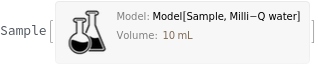
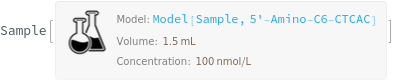
- Sample constructs are used to represent the samples an experiment is expected to produce.
- Sample constructs use the keys: Model, Container, Volume or Mass and Concentration or MassConcentration.
- If the exact amount and/or concentration is unknown this uncertainty can be represented using a distribution.
- Container must point to a container construct. As each container construct is unique, it is possible to discern if samples will be in unique containers.
-
InvalidSample `1`
Input

Output

Messages
Examples
Basic Examples (3)





Additional Examples (6)
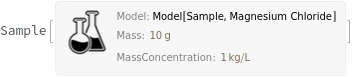
For solid samples, use the mass and a mass concentration keys:

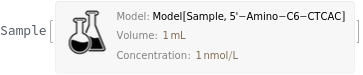
For liquid samples, use the volume and a molar concentration keys:

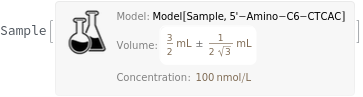
If the exact amount is unknown it can instead be represented with a distribution:

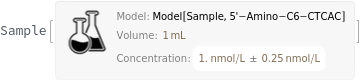
If the exact concentration is unknown it can instead be represented with a distribution:

If the experiment is expected to create an uncertain number of samples, the sample construct can be wrapped in Repeated. Here we represent the case where vacuum evaporation may fill between 1 and 8 tubes with between 0 and 2 mLs of water as it creates needed counterweights:


Represent the case where HPLC may create 0-384 fraction samples. Since only 96 samples will fit in a plate, 4 unique container constructs are used:







