ecl-logo Documentation

SequenceQ

SequenceQ[seq]out

returns True if the provided sequence matches the given Polymer type.

Details

  • Automatic will attempt to match the provided string to any known polymer type.
  • Input
    Output
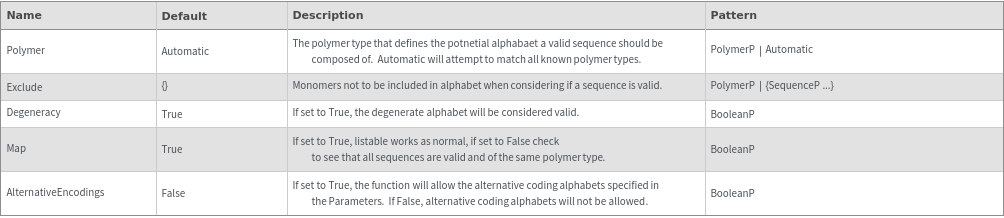
    General Options

Examples

Basic Examples  (4)

Tests if a given input is a oligomer sequence:

Works on any polymer type including RNA:

Or even peptides:

But will return false for anything that's not a known oligomer sequence:

Additional Examples  (3)

Can recognize both explicitly and implicitly typed sequences:

Named motifs are accepted by sequence as well:

Numeric sequences are also OK:

Options  (15)

AlternativeEncodings  (2)

Alternative coding alphabets for the polymer will be checked when AlternativeEncodings is set to True:

If AlternativeEncodings is set to False, then alternative coding alphabets for the polymer will not be permitted in the sequence:

Degeneracy  (4)

If Degeneracy is set to true then degenerate Monomers will be permitted in the sequence:

If Degeneracy is set to false, then degenerate Monomers will not be permitted in the sequence:

Numeric sequences are rejected when Degeneracy is set to False:

Numeric sequences are accepted when Degeneracy is set to True:


Exclude  (2)

Exclude takes a list of Monomers that should not be permitted in the sequence:

Exclude takes a list of Monomers that should not be permitted in the sequence:

Map  (3)

If Map is set to True, listable behavior works as normal:

If Map is set to False, will test to see if all of the sequences are of the same polymer:

If Map is set to False, will test to see if all of the sequences are of the same polymer:

Polymer  (4)

Providing the polymer type will test of the sequence is composed of only Monomers in the polymer's alphabet:

If the provided type doesn't match the sequence, SequenceQ will return false:

Works with explicitly typed sequence as well:

Peptides for instance work as well:

Attributes  (2)

Listable  (2)

The Function is listable:

The function is listable: